
As an Amazon Associate, ToyBuddie earns from qualifying purchases. This does not affect the price you pay.
In this guide
- Best drones for kids at a glance
- How we chose the best drone for kids
- Detailed reviews of each pick
- Best drones for kids by age and budget
- How to choose a drone for kids: what to look for
- Safety and age-appropriateness checklist
- Alternatives and honorable mentions
- Frequently asked questions
- Final recommendation
A first drone for a child has a different job from one you would buy yourself. It needs to survive the ceiling, the sofa and the dog, hover on its own so small hands can learn one stick at a time, and be light enough that a crash breaks nothing. Guards, hover stability and spare batteries matter far more than camera quality or range.
We researched the current market based on manufacturer specs, product details and parent feedback patterns. Below are our picks by age and budget, a buying checklist and the safety rules worth knowing.
Best drones for kids at a glance
These ten picks run from a no-remote flyer for young kids to a sub-250 g camera drone a tween can grow into.
| Product | Best for | Age | Key feature |
|---|---|---|---|
| Holy Stone HS210 | Best overall first drone | 8 to 12 | Full prop guards, altitude hold, 3 speed modes |
| DEERC D20 | Best kids drone with camera | 8+ | 1080p FPV camera, 80° lens, voice and gesture control |
| Ryze Tello Boost Combo | Best for learning to code | 10+ | Scratch programming, 5 MP / 720p camera, 13 min flight |
| Holy Stone HS180 LED | Best light-show starter | 8+ | 7-color LEDs, 3 batteries, about 21 min total flight |
| Veeniix V995 | Best budget nano | 8+ | Auto hover, headless mode, 3 batteries |
| ATOYX Mini Drone | Best for tricks | 8+ | One-touch 3D flips, quieter 4-blade props, altitude hold |
| Force1 Scoot | Best for younger kids | 6+ (with supervision) | Hand-operated, no remote, enclosed cage |
| Holy Stone HS110D | Best mid-range FPV | 10+ | 1080p camera, 2 batteries, bigger frame |
| DJI Neo | Best premium upgrade | 10+ with an adult | 4K camera, palm takeoff, fully enclosed props |
| HoverAir X1 | Best self-flying camera drone | 12+ | Pocket-fold design, automatic flight paths |
How we chose the best drone for kids
We filtered the category on the things that decide whether a first drone is fun or frustrating: crash protection, hover stability, battery count and age grading.
- Propeller guards or an enclosed cage. Our top indoor picks ship with guards or a full cage; confirm the guard style on the budget listings.
- Altitude hold or auto-hover. A drone that stays put when the sticks are released lets a child learn steering before throttle.
- Replaceable batteries. Mini drones fly 5–10 minutes per charge, so two or three packs matter.
- Weight under 250 g (0.55 lb). Everything on this list is under the FAA registration threshold for recreational flying. We cover what that means in our post on drone laws for kids and toy drones.
- Manufacturer age grading. Many toy drones say “for kids” on the box but carry a 14+ warning in the small print because of the battery and small parts. We flag that per product and recommend supervision under 10.
Detailed reviews of each pick
Holy Stone HS210 Mini Drone — best overall first drone

Holy Stone HS210 Mini Drone
Check Price on AmazonPrice and availability change often — check Amazon for current details.
The HS210 is the drone we would hand an 8–11 year old on their birthday, and Holy Stone markets it for kids 8 to 12. It is a palm-sized nano quadcopter with a full 360-degree propeller guard ring that lets it bounce off walls and furniture without damage, plus the three features that make a first flight go smoothly: one-key takeoff and landing, altitude hold and headless mode.
Holy Stone typically includes three batteries at roughly 6–7 minutes each, so a session runs about 20 minutes before a recharge break. Low, middle and high speed settings let you lock it in low speed for a beginner, and toss-to-launch, circle fly and the 3D flip button are the party tricks kids show their friends.
Limitations: no camera, and it is an indoor drone first because a light breeze pushes it around. Some listings carry a 14+ warning for the lithium battery and small parts even though it is marketed for children, so supervise younger pilots and check the listing for the current age grade.
Pros
- Full propeller guards survive indoor crashes
- Altitude hold and headless mode make learning easy
- Three batteries and three speed modes
- Under 250 g, no FAA registration
Cons
- No camera
- Struggles in any wind
- About 6–7 min per battery
DEERC D20 Mini Drone with Camera — best kids drone with camera

DEERC D20 Mini Drone with Camera
Check Price on AmazonPrice and availability change often — check Amazon for current details.
When a child asks for a “drone with a camera,” the D20 is the sensible answer. It is a palm-sized mini drone with a 1080p camera and 80-degree wide-angle lens that streams live first-person video to a phone clipped into the controller. The footage records a backyard flyover fine, but nobody should expect vlog quality at this price band.
DEERC includes propeller guards, altitude hold, headless mode and one-key takeoff and landing, plus app tricks kids love: gesture selfies, voice control and a draw-a-path mode. Two batteries typically give around 10 minutes each.
What to know: the camera is fixed, and the app needs a smartphone and Wi-Fi pairing, which adds a small learning curve. It handles a calm day outdoors a little better than the HS210 because it is slightly heavier.
Ryze Tello Boost Combo — best for learning to code

Ryze Tello Boost Combo
Check Price on AmazonPrice and availability change often — check Amazon for current details.
The Tello is the drone teachers and coding clubs reach for, and it suits a curious 10–12 year old perfectly. Built by Ryze with DJI flight technology, it weighs about 80 g (2.8 oz), hovers steadily thanks to a downward vision sensor, and flies around 13 minutes per charge, the longest of the mini drones here.
The camera shoots 5 MP (2592×1936) photos and 720p video to the Tello app, which also includes preset tricks like 8D flips and throw-and-go. The big draw is programming: kids can control it with Scratch blocks and move on to Python later, which is why it also appears in our guide to electronic toys for 10 year olds.
Limitations: phone control by default (a Bluetooth controller is optional), no onboard video storage, and it does not love wind. Guards are included, and the Boost Combo adds extra batteries and a charging hub over the drone-only box.
Holy Stone HS180 LED Mini Drone — best light-show starter

Holy Stone HS180 LED Mini Drone
Check Price on AmazonPrice and availability change often — check Amazon for current details.
The HS180 is the camera-free, app-free choice: a mini quadcopter with a proper two-stick controller and one-key start, plus 7-color LED lights with six lighting modes that make it easy to track in a dim room or at dusk. The lights also make orientation easier, which helps a child learn which way the nose is pointing.
Holy Stone includes three modular batteries for up to about 21 minutes of total flight, so a session runs long before a recharge break. It is light, so treat it as an indoor and calm-day drone rather than a windy-park drone, and keep an adult nearby for the first few flights.
Veeniix V995 Mini Drone — best budget nano

Veeniix V995 Mini Drone
Check Price on AmazonPrice and availability change often — check Amazon for current details.
The V995 competes directly with the HS210 at the lowest price band here, and it is a fine “let’s see if they stick with it” first drone. It is a palm-sized nano quadcopter with auto hover, headless mode and one-key takeoff and landing, plus 3D flips, 360-degree rotation and circle fly for when the basics are mastered.
Veeniix ships it with three batteries, so flying time per session is similar to the HS210, and the slowest speed setting is gentle enough for a 7–8 year old to follow by eye. Trade-offs: a lesser-known brand than Holy Stone, no camera, and the same indoor-only reality as every nano. Check the listing to confirm the guard style.
ATOYX Mini Drone for Kids — best for tricks

ATOYX Mini Drone for Kids
Check Price on AmazonPrice and availability change often — check Amazon for current details.
The ATOYX mini drone is the showman of the group: one-touch 3D flips that a child can trigger the moment the drone is hovering steadily, on upgraded 4-blade propellers that ATOYX says fly more stably and quietly than standard 2-blade props. For a kid who gets bored of plain hovering, the flips keep it interesting for weeks.
It ships with eight spare 4-blade propellers, altitude hold, headless mode and one-key takeoff and landing; check the listing for the current battery count. The build tolerates a calm patio session. No camera, and the extra buttons can confuse a younger child, so we would pick it for 9–12 year olds who already know the basics.
Force1 Scoot Hand Operated Drone — best for younger kids
Force1 Scoot Hand Operated Drone
Check Price on AmazonPrice and availability change often — check Amazon for current details.
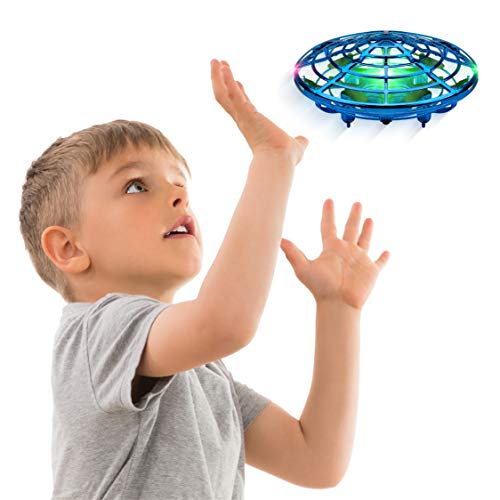
The Scoot, the original model in Force1’s Scoot family, is a glowing LED orb inside a full plastic cage with no remote at all. Toss it up, it hovers, and obstacle-avoidance motion sensors make it dart away from a hand that moves toward it. Kids as young as 6 can play with it because there are no sticks to master and the propellers are completely enclosed.
It charges over USB in roughly 40–60 minutes for about 5–8 minutes of play, the main complaint parents have. It will not teach real flying skills and it is strictly indoor; think of it as the pre-drone that builds interest before a stick-controlled model.
Holy Stone HS110D FPV Drone — best mid-range camera drone

Holy Stone HS110D FPV Drone
Check Price on AmazonPrice and availability change often — check Amazon for current details.
The HS110D is the step up when a 10–12 year old has outgrown a nano and wants a bigger, steadier camera drone for the park. It has a 1080p camera with a 120-degree wide-angle lens and live FPV to a phone, altitude hold, headless mode, one-key takeoff and landing and a stated range of about 330 ft (100 m).
Holy Stone usually includes two modular batteries at roughly 10 minutes each, guards are included, and the larger frame copes with light wind better than any nano here. It is still under 250 g, but too big for a bedroom, and there is no GPS return-to-home, so kids need to understand it is a line-of-sight drone.
DJI Neo — best premium upgrade

The DJI Neo is the smallest camera drone DJI makes, about 135 g (4.8 oz), and it changes what a “kids drone” can be. The propellers are fully enclosed, it takes off and lands from a palm, and it flies preset shots (follow, circle, dronie) with a single button on the drone itself. Video is stabilized 4K/30fps and flight time is around 18 minutes.
Kids control it from a phone app, by voice, or with an optional DJI controller sold separately, the setup we recommend once a child wants to fly manually. It is the most expensive pick here, has no obstacle avoidance and is loud, so we suggest it for 10+ with an adult co-pilot. Our guide to the best $200 drones compares the alternatives in this bracket.
HoverAir X1 — best self-flying camera drone

HoverAir X1 Self-Flying Camera
Check Price on AmazonPrice and availability change often — check Amazon for current details.
The HoverAir X1 is less a drone and more a flying camera that folds to the size of a phone. It weighs about 125 g (4.4 oz), has a fully enclosed propeller housing and launches from an open palm. A child picks a mode (hover, follow, zoom out, orbit) with a button, and it flies the path itself and returns to the hand, recording up to 2.7K; in follow mode it keeps pace at up to about 15 mph.
Flight time is short, around 10–11 minutes, and it barely flies manually, but because it only flies programmed paths it is one of the safest camera drones a 12 year old can use for sports clips. Pick it for a tween who wants footage, not flying lessons.
Want the simplest first drone that survives crashes? Start with the HS210.
Best drones for kids by age and budget
Drone for 6–7 year olds
Go remote-free with the Force1 Scoot: zero sticks, fully enclosed blades. If they insist on a “real” drone, the Veeniix V995 locked in low speed with an adult on the controller is the most forgiving option.
Drone for 8 year olds
This is the sweet spot for a guarded nano. The Holy Stone HS210 or Veeniix V995 both work, and the HS210’s brand support and spare-parts availability are worth the small price difference. Keep flights indoors for the first few weeks.
Best beginner drone for 10 year olds
At 10, most kids can handle two-stick control and want a camera. The DEERC D20 is the best value, the Ryze Tello the best for a coder, and the HS180 LED the best for a long, lights-on flying session without a phone.
Drones for 11–12 year olds
Tweens can step up to the HS110D for a bigger FPV experience, or to the DJI Neo or HoverAir X1 if the goal is filming; pair one with a pick from our best cameras for kids for a budding filmmaker.
By budget
Under $40: Veeniix V995, Holy Stone HS210, Force1 Scoot. Under $75: DEERC D20, ATOYX Mini Drone, HS180, HS110D. Mid-range to premium: Ryze Tello, DJI Neo, HoverAir X1.
How to choose a drone for kids: what to look for
The right kids’ drone has guards, hovers on its own and swaps batteries in seconds; everything else is a bonus.
Propeller guards and enclosed designs
Full-ring guards (HS210 and similar nanos) protect walls, fingers and the props. Fully enclosed cages (Scoot, DJI Neo, HoverAir X1) are safer still and the only type we would consider under age 8. Clip-on guards that come loose in a crash are the weakest design.
Altitude hold and hover stability
Altitude hold keeps the drone at a set height when the throttle is released. Without it, a child manages throttle, pitch, roll and yaw at once, which is why altitude hold matters so much for first-time pilots. If a drone with altitude hold still wanders, see our fix for a drone that keeps drifting.
Headless mode and one-key takeoff
Headless mode makes the controls relative to the pilot instead of the drone’s nose. One-key takeoff and landing avoids the wobbly manual launches behind most first-day crashes. Our kid-friendly guide to how to fly a drone for the first time walks through both.
Indoor or outdoor flying
Nano drones under about 50 g are indoor toys; a mild breeze carries them away. Mini drones of 80–150 g (Tello, HS110D, DJI Neo) handle calm outdoor days. We break this down in indoor vs outdoor drones for kids.
Camera: yes or no?
For an 8 year old, skip it; the phone, app and Wi-Fi pairing get in the way of learning to fly. For 10+, a 720p or 1080p FPV camera is a real motivator, and 4K matters only if the footage will be shared.
Batteries and charging
Look for two or three batteries in the box. Most packs take 40–90 minutes to charge for 6–10 minutes of flight. Let batteries cool before charging and never leave lithium packs charging unattended.
Safety and age-appropriateness checklist
Most toy drone incidents involve fingers near props or a drone flown where it should not be.
- Check the age grade on the listing. Many “kids” drones are rated 14+ for the lithium battery and small parts; supervise younger pilots and keep drones and spare props away from children under 3 (choking hazard).
- Controller on before the drone, drone off first when finished, so it never spins up in a hand.
- Indoors: cleared room, pets out, ceiling fans off, windows closed.
- Outdoors, keep the drone in sight, under 400 ft (122 m), away from people and never near an airport. US recreational flyers are expected to complete the free FAA TRUST test; a parent can do it with the child.
- Tie back long hair and keep fingers clear of the props during landing.
Alternatives and honorable mentions
- Build-it-yourself drone kits (snap-together brick-style frames) suit 9–12 year olds who like construction toys.
- Sub-250 g GPS drones such as the Potensic Atom SE or DJI Mini models are terrific for teens but overkill for the 8–12 range.
- Walkie talkies are a great companion gift for drone days; see the best walkie talkies for kids.
Browse the full drones and electronic toys category.
Frequently asked questions
What is the best drone for an 8 year old?
A nano drone with full propeller guards, altitude hold and headless mode. The Holy Stone HS210 is our top pick because it is built for ages 8 to 12 and has three speed modes, so it stays useful as the child improves. Keep the first few weeks indoors and supervise charging.
Do kids need to register a toy drone with the FAA?
No, as long as the drone weighs under 250 g (0.55 lb) and is flown for fun. Every drone on this list is under that limit. Recreational pilots are still expected to pass the free FAA TRUST safety test and follow basic rules such as staying under 400 ft and keeping the drone in sight.
Are drones with cameras good for kids?
For children 10 and up, yes. A 1080p FPV camera like the one on the DEERC D20 or Holy Stone HS110D adds a lot of fun. For younger kids the camera, app and phone pairing get in the way of learning to fly, so we suggest a simple nano drone first.
How long do kids’ drones fly on one battery?
Most nano and mini drones fly 5–10 minutes per battery, which is why we prefer models with two or three packs. The Ryze Tello (about 13 minutes) and DJI Neo (about 18 minutes) last longer. Charging takes 40–90 minutes per pack.
What is the easiest drone for a complete beginner to fly?
A drone with one-key takeoff, altitude hold and headless mode, such as the Holy Stone HS210, Veeniix V995 or DEERC D20. Those three features remove the hardest parts of flying so a child can focus on steering. The DJI Neo and HoverAir X1 are even easier because they fly preset paths automatically.
Final recommendation
For most families, the Holy Stone HS210 is the best drone for kids starting out: cheap enough that a crash does not matter, guarded enough to survive one, and equipped with the auto-hover features that make a first flight a success. Choose the DEERC D20 if a camera is the point, the Ryze Tello for a coder, and the DJI Neo for a premium camera drone that can grow with them. Whichever you pick, add the free FAA TRUST certificate to the list and start the first flight in a cleared room.